


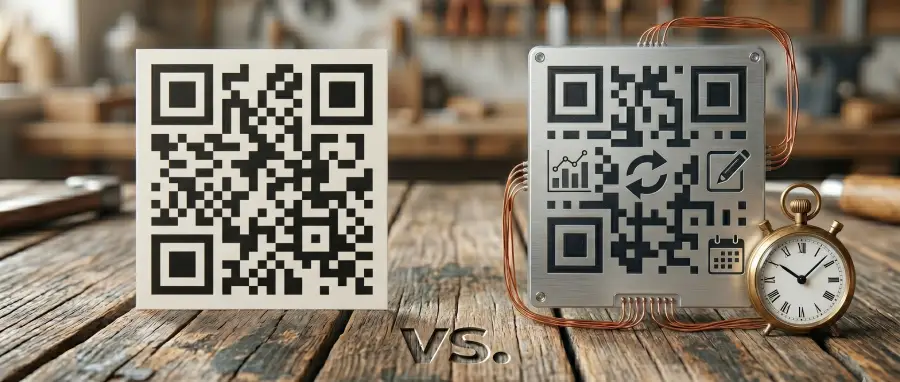
You’ve decided to create a QR code — for a business card, a restaurant menu, a product label, or a marketing campaign. You open a QR generator and the first question hits you: static or dynamic?
The answer takes three minutes — but getting it wrong can cost you for years. We’ve seen 500 business cards tossed in the trash, a restaurant reprinting its menu every month, and a marketing campaign whose scan source could never be tracked. This guide is written so you make that three-minute decision correctly the first time.
Is Your QR Code Static or Dynamic? How to Tell
If you already have a QR code and aren’t sure which type it is, three quick tests will tell you.
Test 1: Scan It and Watch the URL
Scan the code with your phone and look at the URL bar. Static: goes straight to the destination (e.g. example.com/menu.pdf). Dynamic: you’ll briefly see a short redirect URL first (e.g. kod.kim/abc123, qrco.de/xyz) before landing on the actual content.
Test 2: Check Your Provider Account
Log into the site where you created the QR code. If you see options like “Edit,” “Change destination,” or “Update target URL,” it’s dynamic. Static QR codes can’t be edited; once they’re generated, the provider has no further connection to them.
Test 3: Are There Scan Statistics?
If your provider dashboard shows “total scans,” “scan dates,” “scans by city,” or any similar reporting, you have a dynamic QR code. Static codes don’t route through any server, so collecting this data is impossible.
🔍 Visual Hint
Not a hard rule, but a useful tell: if the QR code looks visually dense and complex, it’s probably static. Static codes embed all data directly in the matrix, so the more content you encode, the more modules pile up and the busier the code looks. Dynamic codes only encode a short redirect URL, so they tend to look cleaner and more sparse. Use this as a quick visual check; for a definitive answer, run one of the three tests above.
What Is a Static QR Code?
In a static QR code, the destination data (URL, phone number, vCard, WiFi credentials, etc.) is encoded directly into the QR matrix itself. When someone scans it, their phone reads the content from the matrix — no server lookup, no redirect.
The operating principle is “generate once, unchanged forever.” It has no ongoing relationship with the provider; even if your generator goes out of business, the QR code keeps working.
Advantages of Static QR Codes
- Free and permanent. No subscription, no renewal, no recurring cost — ever.
- Works offline. Since the data lives in the QR matrix, the scanner doesn’t need an internet connection to read WiFi credentials, phone numbers, vCards, or plain text.
- No provider dependency. If the generator site shuts down, deletes your account, or starts charging for what was free, your static QR keeps working. The only thing it depends on is physical readability.
- Direct-to-contacts for vCards. With static vCard QR codes, the contact data lives in the matrix, so scanning adds the contact directly to the phone’s address book — no intermediary web page. This one-tap experience is something dynamic vCards typically can’t offer.
Disadvantages of Static QR Codes
You can’t edit it after it’s printed
This is the most critical limitation of static QR codes. Once you’ve generated and printed it, you can’t change a single character of the content.
⚠️ A REAL-WORLD EXAMPLE
A law firm printed 1,000 business cards. The static vCard QR codes contained phone, email, and office address. Eight months later the firm relocated. Every single card had to be thrown out. Reprint plus redesign: roughly $200. With dynamic QR codes, updating the address from the dashboard would have taken 30 seconds.
More data = more cluttered code
Because all the data lives inside the matrix, the rule is: more data = more modules = smaller, denser QR code. If you encode a vCard with 7-8 fields, the code becomes so visually busy you can barely tell where one module ends and the next begins.
Dense QR codes are especially hard to scan on lower-end phones with weaker cameras. If your audience uses budget devices, your scan success rate drops noticeably. With dynamic QR codes, the matrix only contains a short redirect URL — the code stays sparse, clean, and reliably scannable.
No scan analytics
Because static codes never route through a server, there’s no way to collect scan data. You’ll never know how many people scanned it, when they scanned, which cities they scanned from, what devices they used (iOS vs. Android), or which version of a campaign — A or B — performed better.
For marketing campaigns or any kind of corporate deployment, this is a blind spot. You can print 10,000 brochures and have no idea what worked. How are you going to improve the next one?
Limited design flexibility
To add a logo to a static QR code, you have to bump up the error correction level. That adds even more modules, making the code denser and harder to scan. Getting a static QR that’s both branded and reliably readable is much harder than with a dynamic one.
What Is a Dynamic QR Code?
In a dynamic QR code, the matrix doesn’t contain the actual content — it contains a short redirect URL (e.g. kod.kim/abc123). When someone scans, their phone hits this short URL first, then gets forwarded to the real destination.
The actual content (menu, vCard, campaign page, product info) lives on the provider’s server. That’s what lets you update the content as often as you want without ever changing the printed QR code.
Advantages of Dynamic QR Codes
- Editable after printing. You can change the destination URL, vCard fields, menu PDF, or campaign target from the dashboard — without modifying the printed QR at all. Your business cards, brochures, and labels stay in circulation.
- Detailed scan analytics. Total scans, scan times, scan locations, device types — everything is in your dashboard. Critical input for any marketing decision.
- Cleaner, more scannable matrix. Because the matrix only contains a short URL, the QR code itself stays sparse. It scans easily even on older phones with poor cameras.
- A/B testing. Run two versions of the same brochure with different QR codes and measure which performs better.
- More design freedom. Logo embedding, color customization, frame styling — there’s far more room to play with.
- Multiple content over time. One dynamic QR can serve different content at different times — a campaign page during launch, then a product catalog afterwards.
Disadvantages of Dynamic QR Codes
Being honest about the downsides is important. Knowing them up front is how you avoid regret later.
Provider lock-in
Dynamic QR codes route through the provider’s server. If the provider shuts down, kills the service, or terminates your account, your printed QR codes stop working. This is the single biggest trap in the QR industry.
⚠️ THE “FREE” TRAP
Many QR providers attract users with the promise of a “free dynamic QR code.” The user generates the code, prints thousands of business cards or brochures, and distributes them. Months later, a notification arrives: “To keep your QR code active, please upgrade to our $9/month plan. Your code will be deactivated in 7 days.” At that point the user has two options: pay roughly $108 per year indefinitely, or throw out all the printed materials and start over — often a far bigger expense than the subscription itself.
This trap is especially hard to spot because the phrase “free dynamic QR code” appears prominently on most provider sites; the paywall is buried in fine print or revealed only after you’ve committed.
How we approach this at qrcodeg.com: Static QR codes are genuinely free and unlimited, with no time limit. Dynamic QR codes are offered with a one-time annual payment, and renewal is optional — not enforced. We display the free/paid distinction prominently on every page; we consider the “free now, pay later” model harmful to the industry.
Requires an internet connection
If the person scanning doesn’t have internet, the dynamic QR can’t reach the redirect server, and the content never loads. This matters at event venues with poor reception, on flights, in rural areas — anywhere connectivity is spotty.
Annual or monthly fee
Dynamic QR codes require provider infrastructure, so they’re not free. Pricing models vary: monthly subscription, annual subscription, one-time annual fee with optional renewal. Pick the model that fits your budget and how long you plan to use the code.
Which Should You Choose for Each Use Case?
The table below summarizes which QR type is best suited for the most common scenarios.
| Use Case | Recommended | Why |
|---|---|---|
| Professional business card (vCard) | Dynamic | If you change jobs, phones, or addresses, your printed cards aren’t wasted. Plus you get scan analytics. |
| URL / web page | Dynamic | The destination URL can change; analytics measure marketing performance. |
| Social media (multi-link / Linktree) | Dynamic | Social handles and campaign links evolve constantly; a single QR can serve all your current links and update them over time. |
| PDF document (brochure, catalog, price list) | Dynamic | Catalogs update every season; the same QR can serve a new PDF without reprinting anything. |
| Restaurant menu | Dynamic | Menus, prices, and items change constantly. Static means reprinting at every update. |
| Product label | Dynamic | Product info, warranty status, or user manuals can be updated post-print. |
| Marketing campaign / advertising | Dynamic | Analytics are critical; campaigns evolve; A/B testing is often required. |
| Event / wedding invitation | Dynamic | Times, venues, or details can change. Update via the QR instead of reprinting cards. |
| Location sharing (fixed address) | Static | If the address won’t change for years, static is sufficient and free. |
| Location sharing (changing location) | Dynamic | Pop-up shops, mobile events — the location needs to be updatable. |
| Pet collar | Dynamic | Phone numbers change; owner info needs to stay current. |
| WiFi password (home or café) | Static | Must work offline; passwords rarely change. |
| Quick text / short message | Static | One-time, short-form info; static is fast and sufficient. |
5 Questions to Ask Yourself Before Deciding
- Could the content change in the next 1-3 years? If the answer is “yes” or “maybe,” go dynamic. Only if it’s “never” should you consider static.
- How many copies will you print? If the print run is large (1,000+ cards, brochures, labels), the cost of reprinting is steep — dynamic eliminates that risk entirely.
- Does it matter who scanned, and when? For marketing, sales, or corporate reporting, “yes” means dynamic is non-negotiable.
- How long will the QR be in use? If you know the campaign ends in 1-2 months, static is fine. For ongoing or open-ended use, dynamic.
- Can your budget cover the annual fee? Only if this answer alone is “no” should you default to static. The value dynamic provides typically pays for itself on the other four questions.
Conclusion
Static QR codes are simple, permanent, and free — but unchangeable and analytics-blind. Dynamic QR codes are flexible and measurable — but provider-dependent and paid.
The general rule: one-time use, fixed content, small print runs → static is enough. Professional use, ongoing deployment, anything that might change, anything that needs analytics → dynamic is required.
The most important factor in the decision isn’t actually static vs. dynamic — it’s which provider you choose. Across the industry, “free dynamic QR” promises that later turn into mandatory subscriptions have forced thousands of businesses to discard printed materials worth far more than the subscription itself. In our next article, we compare QR code providers head-to-head on pricing model, transparency around free vs. paid, included features, and long-term sustainability.
Ready to Get Started?
Free static QR codes for one-time use, or a one-time annual payment for fully managed dynamic QR codes. Whichever you choose: no hidden fees, no surprise renewals, no paywalls disguised as features.